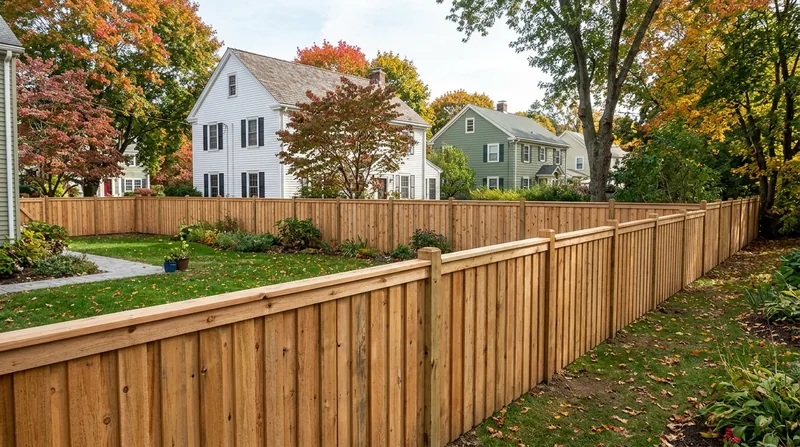




Boston's classic 6-foot privacy fence installation demands posts set deep in concrete and materials that survive freeze-thaw cycles, salt spray near the harbor, and the rocky glacial till that runs under most yards in the city and suburbs. Whether you're protecting a tiny triple-decker backyard in Dorchester or a larger colonial lot in Newton or Wellesley, a well-built wood fence starts with honest material choices, proper post depth, and realistic expectations about maintenance. We tell you when cedar fence installation is worth the premium and when pressure-treated pine delivers the same 15 to 20 years of service at half the cost. This page covers how we build privacy fences in Boston, what the work costs, and what to look for when hiring a contractor who knows New England conditions.
Why a Properly Built Privacy Fence Matters in Boston
Boston winters drive posts down and frost heaves them back up each spring. Nor'easters push wet snow against fence lines and bury sections under drifts. Road salt and harbor salt corrode metal fasteners and hardware. Mature maples and oaks shed branches onto fences, and the rocky soil forces post holes through glacial till and sometimes into buried ledge. A fence built to handle these conditions stays upright for decades; one that cuts corners on post depth, concrete, or fastener quality fails in 5 to 7 years.
- Posts set 3 to 4 feet deep in concrete resist frost heave and wind load better than shallow tamped installations.
- Galvanized or stainless fasteners resist salt corrosion far longer than plain steel nails and screws.
- Board-on-board or side-by-side construction sheds water and snow better than single-sided pickets.
- White-cedar heartwood and pressure-treated pine are the materials that last in this climate; vinyl and chain link are also built to code but serve different needs.
Getting these details right from the start is the difference between a fence that ages gracefully and one that rots, leans, or fails at the first heavy storm.
Key info: A 6 foot privacy fence in Boston typically runs from $27 to $45 per linear foot depending on material (treated pine versus cedar), whether you choose board-on-board or side-by-side construction, and site conditions like rocky soil or ledge. See our pricing guide for a detailed breakdown and free estimate.
For more on when repair makes sense versus replacement, visit our fence repair page.
Massachusetts law requires a utility locate before digging. Call 811 or visit Mass 811 to mark underground gas, electric, and water lines on your property before we set posts.
How We Install Wood and Privacy Fences in Boston: Step by Step
Our process starts with a clear property line, a walk of the entire fence run, and a realistic conversation about material choices and your budget. We mark out post locations, call for a utility locate, and then dig or auger post holes to 3 to 4 feet, depending on soil and frost depth. Posts go into concrete, not just tamped earth. We set stringers (horizontal rails) level and square, then attach pickets with galvanized fasteners, spacing them to match your design (board-on-board for maximum privacy, side-by-side for a more open look, or spaced pickets for a less dense appearance).
- We confirm your property line and verify any deed restrictions or HOA rules before we stake a single post hole.
- We call 811 and wait for the utility locate ticket before breaking ground.
- We dig post holes to 3 to 4 feet and set posts in concrete to resist frost heave and wind load.
- We install level stringers and attach pickets with galvanized fasteners, spacing them to your design preference.
- We cap the top rail and trim the fence line straight and true, with no leaning sections or gaps that collect water.
The entire job typically takes 3 to 5 days for a 100-foot run, depending on soil conditions and whether we encounter ledge or rocky till.
Local example: A typical South Boston triple-decker lot with a 60-foot backyard fence, rocky glacial soil, and tight site access costs between $1,600 and $2,400 for a treated-pine board-on-board fence, installed in 2 to 3 days. A similar fence in Milton or Wellesley, on a larger lot with better access, runs closer to $1,400 to $2,000 for the same 60 feet. Cedar costs 30 to 50 percent more but holds color and resists rot better in high-moisture areas.
Learn more about our fence replacement and removal services if you're taking down an old fence first.
Wood Fence Installation Methods: Board-on-Board, Side-by-Side, and Spaced Picket
| Approach | Description | Best for |
|---|---|---|
| Board-on-Board | Pickets overlap slightly on both sides of the stringers, creating a shadow-box effect. Maximum privacy and wind resistance. Pickets are typically 1 inch by 6 inches or 1 inch by 8 inches. | Boston townhouses, small yards, and properties where privacy and wind protection are priorities. Slightly higher material and labor cost than side-by-side. |
| Side-by-Side | Pickets are butted edge-to-edge on one side of the stringers, creating a solid vertical line. Standard privacy fence. Pickets are typically 1 inch by 6 inches, spaced tight or with minimal gaps. | Most residential applications in Boston and suburbs. Clean, simple look. Slightly less wind resistance than board-on-board but still fully private. |
| Spaced Picket | Pickets are separated by 1 to 2 inches, creating a semi-private appearance. Allows light and air to pass through. Common in front yards and decorative applications. | Colonial homes in Newton, Needham, and Wellesley where front-yard aesthetics matter. Also used for side yards where some visibility is acceptable and wind load is less critical. |
| Cedar Heartwood vs. Pressure-Treated Pine | Cedar heartwood resists rot naturally and ages to a silver-grey without stain. Pressure-treated pine is kiln-dried after treatment and holds paint or stain better. Both survive 15 to 20 years in Boston's climate with proper drainage and fasteners. | Cedar for high-moisture areas, visible yards, or when natural appearance is preferred. Treated pine for budget-conscious builds or when the fence will be painted. Cedar costs 30 to 50 percent more upfront but requires less maintenance stain. |
Each method is built to the same post depth and concrete standard; the choice is about privacy level, wind performance, and aesthetics.
Wood and Privacy Fence Installation Cost in Boston: What to Expect
Privacy fence installation in Boston starts at $27 per linear foot for pressure-treated pine, side-by-side construction on level ground with good access and no ledge. That baseline assumes posts set 3 to 4 feet deep in concrete, galvanized fasteners, and standard 1-inch by 6-inch pickets. Real jobs rarely stay at baseline. Rocky glacial soil, buried ledge, steep slopes, tight site access, mature trees, or proximity to buildings push costs up. Cedar costs 30 to 50 percent more than treated pine. A 6 foot privacy fence in a typical South Boston or Dorchester backyard runs $1,600 to $2,400 for 60 feet; the same run in Milton or Wellesley, with better access and less rocky soil, might cost $1,400 to $2,000.
The smartest approach is to get 2 to 3 estimates from contractors who walk the full line, ask about soil conditions and ledge, and explain why their price is what it is. A cheap estimate often means corners cut on post depth, concrete, or fastener quality, and you'll pay for it in 5 to 7 years when frost heave or rot sets in.
Visit our pricing page for a detailed cost breakdown by material, height, and construction method.
Wood and Privacy Fence Installation Near Me: What Boston Homeowners Should Know When Hiring a Contractor
Hiring a local contractor who knows Boston's soil, climate, and permitting rules is worth far more than a low bid from someone unfamiliar with freeze-thaw cycles, nor'easters, and rocky till. Before you commit, confirm that the contractor carries workers' compensation and general liability insurance and can provide a certificate on request. Ask about references and call at least two. Understand that fence height and setback rules vary by neighborhood, and many communities in Greater Boston require a permit before installation; your contractor should know the local rules and help you navigate them. If your property is in an HOA community, check your deed restrictions and architectural guidelines; many require approval of height, material, and color before work begins.
- Verify that the contractor is fully insured with both general liability and workers' compensation coverage, and request a certificate of insurance before signing the contract.
- Check references from at least two recent fence jobs in your neighborhood or nearby towns.
- Confirm that the contractor understands local permit requirements and will help you apply if needed; rules vary across Boston, Quincy, Newton, Brookline, and other service areas.
- If you live in an HOA community, have the contractor review your architectural guidelines and confirm that your design meets height, material, and color rules.
- Ask the contractor to explain how they handle rocky soil and ledge if it's present on your property; a vague answer is a red flag.
Fence licensing in Massachusetts is set county by county, and the specific requirements depend on your municipality and the job scope. Your local building department can tell you whether a permit is required and whether a general contractor license applies to your project. We are fully insured and can help you understand the permitting process and provide documentation for your records.
Call us for a free, no-obligation estimate at (857) 767-9232. We'll walk your property, answer your questions, and give you a realistic price before you decide.
Wood & Privacy Fence Installation in Boston: Pricing Guide
| Service | Price | Details |
|---|---|---|
| Pressure-treated pine, side-by-side, standard height | Starting at $27/ft | Includes posts set 3 to 4 feet deep in concrete, galvanized fasteners, level stringers, and straight picket installation on level ground with good access |
| Cedar heartwood or board-on-board construction | Starting at $38/ft | Cedar costs 30 to 50 percent more than treated pine; board-on-board adds labor and material cost but provides maximum privacy and wind resistance |
| Rocky soil, ledge, steep slope, or tight access | On estimate | Glacial till, buried boulders, or site constraints require an on-site assessment before pricing; extra labor for auger work or ledge removal applies |
| Travel and site visit | Included | No separate call-out or mileage fee for jobs in Boston and surrounding service areas; free estimate within 24 hours |
| Permit assistance and design consultation | Included | We help you understand local height, setback, and HOA rules and explain permit requirements before work begins |
Indicative pricing, the exact cost depends on square footage, finish, and site access. Free personalized estimate within 24h at (857) 767-9232.


