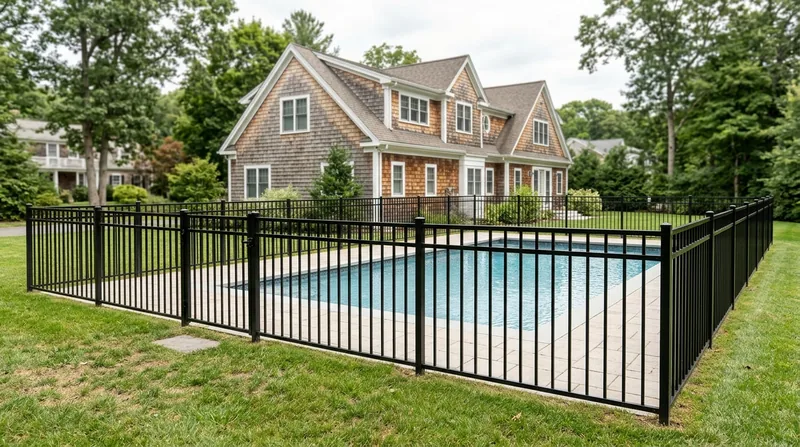




Pool fence installation in Boston requires more than standard fencing knowledge. Boston's rocky glacial terrain, deep winter frost cycles, and the code requirements that protect children demand precision in post placement, gate hardware, and barrier design. Whether your backyard sits on a drumlins hillside in Newton, a narrow triple-decker lot in Dorchester, or a colonial property in Milton, a pool barrier must survive repeated freeze-thaw heave, hold its latch alignment year-round, and meet Massachusetts pool safety code from day one. We install aluminum, mesh, and glass pool barriers with posts set below the frost line and self-closing gates that work in January as reliably as they do in July. Before we dig a single hole, we walk the local code requirements with you, call for a Massachusetts 811 utility locate, and make sure the barrier will serve your family safely for years.
Why Pool Barrier Code Compliance Matters in Boston Backyards
Massachusetts pool barrier law sets specific height, gate hardware, and spacing requirements that vary slightly by municipality and apply to any residential pool. A barrier that looks right but misses the code by an inch or a latch specification creates liability and fails inspection. Boston's freeze-thaw cycle is particularly unforgiving: posts heave, wood swells and shrinks, and gates that aligned perfectly in October bind or hang loose by March. The code exists because children drown, and a self-closing, self-latching gate with proper post depth is the difference between a compliant barrier and a liability.
- We verify the pool barrier code that applies at your address before any estimate is given.
- Posts are set below the frost line so winter heave does not move the gate latch out of alignment.
- We specify self-closing, self-latching hardware rated for pool barrier service and tested for durability.
- Mesh, aluminum, and glass barriers all meet the required spacing and height standards when installed correctly.
- Final inspection rests with your local authority having jurisdiction, and we install to meet those standards.
A properly installed pool barrier protects your family and keeps your property compliant with state law.
Key info: Massachusetts requires pool barriers for any residential pool, and height, gate hardware, and post spacing are non-negotiable. A barrier installed to code in Needham or Brookline meets the same safety standard as one in Boston or Milton. We work from your local building department's requirements and walk you through them before we start.
For detailed state pool barrier rules, see the Massachusetts Department of Public Health pool safety guidance.
How We Install Pool Barriers: Step-by-Step Process in Boston
Our process starts with understanding your local code, the pool layout, and the terrain. Boston-area backyards vary wildly: tight yards in South Boston and Jamaica Plain have little room for error, while properties in Newton and Wellesley may have ledge just below the surface where post holes should go. We mark out the barrier line with you, call for utilities, assess the soil and any obstacles, and then set posts deep enough to stay put through ten winters of freeze-thaw cycles. Every gate is hung and tested before we leave the site.
- We review the pool barrier code that applies at your address and confirm height, spacing, and gate hardware requirements.
- We walk the pool perimeter with you, identify any terrain challenges (ledge, tree roots, slopes), and mark the barrier line.
- We call for a Massachusetts 811 utility locate to mark buried lines before digging any post holes.
- We dig post holes to depth, set posts in concrete below the frost line, and ensure proper spacing for mesh or panel installation.
- We install the barrier material (mesh, aluminum, or glass) with all fasteners and clips secured according to code.
- We hang the self-closing, self-latching gate and test it repeatedly to confirm proper operation and latch engagement.
- We perform a final walk-around with you and review maintenance and inspection intervals.
The entire process is designed so the barrier works safely from day one and stays compliant through Boston's harsh winters.
Local example: A Brookline property with a sloped backyard and granite ledge at 18 inches required post holes on two levels, with the lower posts set deeper to compensate for grade. We stepped the barrier height to meet code on both levels and installed a cantilever gate at the high point so it swings freely without binding on the slope. The entire job took three days, and the barrier has passed two winter seasons without heave or gate misalignment.
For more on gate installation and hardware, see our gate installation and repair service.
Pool Barrier Materials: Aluminum, Mesh, and Glass
| Material | Description | Best for |
|---|---|---|
| Aluminum | Powder-coated aluminum panels with self-closing hinges and latch hardware. Durable, low-maintenance, and resists corrosion from salt air near the harbor. | Properties in Hingham, Weymouth, and coastal Boston neighborhoods where salt spray is a factor. Also ideal for modern aesthetics and minimal maintenance. |
| Mesh (Removable) | Lightweight polyethylene mesh stretched between aluminum or steel posts with tension bands. Can be removed seasonally or stored when the pool is closed. | Homeowners who want to open up the backyard in winter or prefer a less permanent visual presence. Common in suburban Boston neighborhoods with small yards. |
| Glass | Tempered glass panels with aluminum framing and self-closing hinges. Offers unobstructed views and a premium appearance while meeting all safety code requirements. | High-end properties in Newton, Wellesley, and Dedham where aesthetics and views matter. Also used when homeowners want to supervise the pool area visually. |
| Aluminum (Slat) | Solid aluminum slats mounted on aluminum posts, resembling a privacy fence but meeting pool barrier spacing and hardware requirements. | Backyards where privacy is desired alongside code compliance. Provides wind and sound screening while protecting the pool perimeter. |
Each material meets Massachusetts pool barrier code when installed correctly. The choice depends on your budget, aesthetic preference, maintenance tolerance, and whether you want to remove the barrier seasonally.
Pool Fence Installation Cost in Boston: What to Expect
Pool barrier costs in the Boston area start at approximately $34 per linear foot for a basic mesh barrier with aluminum posts and self-closing gate hardware. A typical 40-foot perimeter barrier with a single gate runs $1,360 to $2,000 before any site-specific adjustments. Aluminum and glass barriers run higher, typically $45 to $65 per linear foot, depending on panel design and gate complexity. The final price depends on terrain, soil conditions, tree roots or ledge, gate specifications, and whether posts must be set deeper than standard to account for slope or frost heave risk.
Several factors move costs up from the starting point. Rocky terrain or buried ledge may require hand-digging, drilling, or professional excavation to set posts at the required depth. Steep slopes or uneven grades require stepped installation and custom gate hanging. Multiple gates, specialty hardware, or premium materials like tempered glass add to the total. Access constraints in triple-decker yards or narrow alleys in Dorchester or South Boston may require hand-carrying materials and working in confined spaces. Tree roots near the barrier line complicate post placement and sometimes require root cutting.
We always recommend getting 2 to 3 estimates from contractors who understand Boston's terrain and code requirements. A low estimate that ignores frost depth or ledge depth is a red flag. The best value is a barrier installed correctly the first time so it passes inspection and survives ten winters without gate heave or post failure.
For a detailed breakdown of material costs and labor rates, see our full pricing page.
Choosing a Pool Fence Contractor Near Boston: What to Look For
Hiring the right contractor for pool barrier installation means checking insurance coverage, understanding how fence licensing works in Massachusetts, and verifying that the contractor knows your local code. Fence work in Massachusetts is not uniformly licensed across the state, but many municipalities require permits for pool barriers, and some require inspection before the barrier is considered compliant. Always verify permit requirements with your local building department before work starts. Homeowners associations and deed restrictions may also impose height, material, or color requirements that override personal preference, so confirm any HOA rules before contracting.
- Confirm that the contractor carries general liability and workers' compensation insurance and can provide a certificate of insurance on request.
- Ask the contractor to verify the pool barrier code that applies at your specific address and walk you through the height, spacing, and hardware requirements.
- Request references from recent pool barrier installations in your neighborhood or similar terrain (e.g., sloped lots, rocky soil, or coastal properties).
- Confirm that the contractor will call for a Massachusetts 811 utility locate before digging any post holes and will not proceed without it.
- Get estimates in writing that itemize material, labor, gate hardware, and any site-specific adjustments (ledge, slope, tree roots).
- Verify whether permits are required in your municipality and whether the contractor will handle the permit application and final inspection coordination.
- Ask whether the contractor will walk the barrier line with you before installation and confirm the gate location and swing direction.
A trustworthy contractor will answer these questions clearly and will not rush you into a contract before you understand the scope and local requirements.
For a free estimate and to discuss your specific pool barrier needs, contact us today or call (857) 767-9232. We respond within 24 hours and work across Boston, Quincy, Newton, Brookline, Milton, and surrounding communities.
Pool Fence Installation in Boston: Pricing Guide
| Service | Price | Details |
|---|---|---|
| Mesh barrier with aluminum posts | Starting at $34/ft | Self-closing gate included. Price assumes level terrain and accessible backyard. Rocky soil or ledge increases cost. |
| Aluminum slat or panel barrier | Starting at $45/ft | Solid panels with powder-coated aluminum frame. More durable and maintenance-free than mesh. Terrain and gate complexity affect final price. |
| Tempered glass barrier | Starting at $60/ft | Premium option with unobstructed views. Requires precise installation and specialty hardware. Ideal for high-end properties in Newton or Wellesley. |
| Site challenges (ledge, steep slope, tree roots) | On estimate | Hand-digging, drilling, or stepped installation require on-site assessment. We provide a detailed quote after site visit. |
| Travel | Included | No separate call-out or mileage fee within Boston and surrounding service areas. |
| Free estimate | Free | Response within 24 hours at (857) 767-9232. No obligation to book. Includes site walk and code review. |
Indicative pricing, the exact cost depends on square footage, finish, and site access. Free personalized estimate within 24h at (857) 767-9232.


