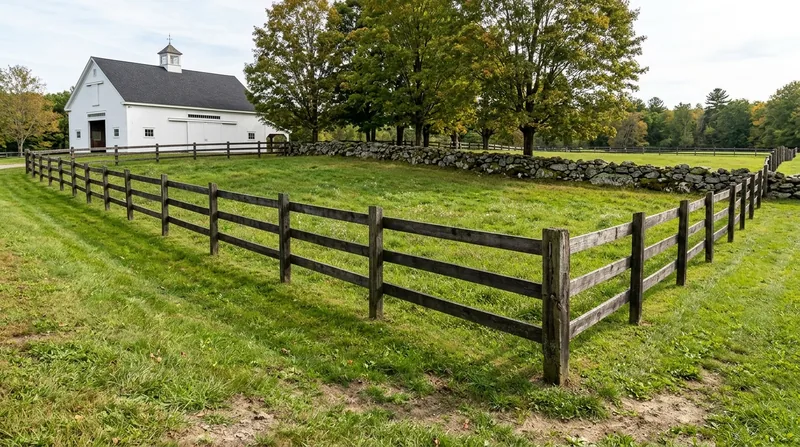




Farm fence installation in Boston and the surrounding counties requires more than standard residential fencing know-how. Greater Boston's rolling glacial terrain, rocky till, buried ledge, and deep winter frost cycles demand posts set deep in concrete, braced corners, and materials chosen for salt air and repeated freeze-thaw heave. Whether you are fencing acreage in Newton, Milton, Needham, or the South Shore, ranch rail, split-rail, no-climb horse fence, and pipe fencing must be installed to hold ground and livestock through nor'easters, ice-load winters, and the thaw cycles that push posts upward every spring. We install straight lines over uneven ground, set posts for frost depth, brace corners and gate openings, and size gates for trailers and farm equipment. This is the work of a local crew that knows the soil, the weather, and the animals.
Why Farm & Ranch Fencing Matters on Greater Boston Acreage
Residential fence rules do not apply to farm and ranch properties. Setback, height, and material restrictions that govern triple-decker yards in Dorchester or colonial lots in Brookline are often waived for working land. What does matter is that fencing must hold livestock, withstand seasonal frost heave and gale-force wind, and remain straight and functional year after year. Boston's freeze-thaw cycles are relentless: ground heaves in winter, settles in spring, and posts that are not set deep enough in concrete will lean and fail within three to five years. Rocky glacial soil means post holes often hit ledge, require blasting or removal, and demand experience with the actual ground you are digging into.
- We set posts below frost depth (typically 42 inches in the Boston area) to prevent seasonal heave and leaning.
- We brace corners and gate posts with diagonal or cross-bracing to resist wind load and the lateral pressure of livestock and snow.
- We install ranch rail, split-rail, no-climb horse fence, and pipe fencing with materials and spacing chosen for the animals and the terrain.
- We work from your property line and existing survey, locating utility lines before we dig any post hole.
- We size gates for trailers, equipment, and farm access, with self-closing and self-latching hardware where needed.
Fencing that holds through a Boston winter is not a luxury, it is a necessity.
Key info: Massachusetts law requires an 811 utility locate call before any digging. We place that call as part of our process. Frost depth in Norfolk, Middlesex, Plymouth, and Essex counties averages 42 to 48 inches. Posts set shallower than that will heave in winter and lean by spring.
For more information on acreage fencing and site-specific challenges, visit Mass.gov's 811 utility locate requirements.
How We Install Farm & Ranch Fencing: A Step-by-Step Process
Every farm and ranch job begins with a site visit. We walk the property with you, identify the line you want to fence, check for ledge and obstacles, note drainage and wet spots, and measure the perimeter. We call 811 to locate buried utilities. We discuss the type of fencing (ranch rail, split-rail, no-climb, pipe, or wire), post spacing, gate locations and sizes, and any bracing or reinforcement needed for the terrain or animals. Once we agree on scope and price, we return to install.
- We call 811 and mark the utility locate marks at least 48 hours before digging.
- We lay out the fence line using string and stakes, marking corner posts and gate locations.
- We dig post holes below frost depth, working around ledge or removing it as needed.
- We set posts in concrete, ensuring they are plumb and braced, then allow concrete to cure before hanging rails or wire.
- We install rails, wire, or pipe, spacing them to code and the animal type (horses require smaller no-climb openings than cattle).
- We install and hang gates with hinges, latches, and self-closing hardware, and test all swings and locks.
- We clean the site and remove debris.
A typical acreage fence takes two to five days depending on perimeter, terrain, and the number of gates.
Local example: A five-acre property in Milton with rocky ground, two gate openings, and split-rail fencing around pasture required ledge removal at two corners, 42-inch post depth, and cross-bracing on both gates to resist wind and livestock pressure. The job took four days. Frost depth and the rocky till are the norm here, not the exception.
See our full gate installation and repair service for details on hardware, swing styles, and automatic openers.
Farm & Ranch Fencing Methods and Materials
| Method | Description | Best for |
|---|---|---|
| Split-Rail | Rustic cedar or pressure-treated rails mortised into posts, typically two or three rails high. Classic appearance, low maintenance. | Horses, cattle, aesthetic appeal, larger properties in Newton and Wellesley. |
| Ranch Rail (Pipe) | Steel pipe (typically 1.5 or 2 inch) bolted or welded to posts. Extremely durable, no rot, handles heavy livestock and snow load. | Horse operations, high-traffic areas, properties where durability and low maintenance are priorities. |
| No-Climb Horse Fence | Woven wire or welded mesh (typically 2x4 inch openings) with top and bottom rails, preventing horses from climbing or getting hooves caught. | Horse pastures, equestrian properties, areas requiring code-compliant containment and injury prevention. |
| Field Wire & Barbed Wire | Galvanized wire stapled to posts, with or without barbs. Lightweight, economical, requires post spacing and tension for security. | Cattle, perimeter fencing on large acreage, areas where cost and ease of repair are key factors. |
Each method is chosen based on the animals, the terrain, local weather, and your budget. We recommend the material that will hold longest and cost least over time, not the cheapest install price.
Farm & Ranch Fencing Cost in Boston: What to Expect
Farm and ranch fencing costs vary widely based on terrain, materials, and the number of gates. Starting at $12 per linear foot for basic split-rail or field wire on level ground with easy digging, costs rise with rocky soil, ledge removal, post bracing, gate hardware, and site access. A five-acre property with two gates and challenging terrain can easily run $8,000 to $15,000 or more. Getting two or three estimates is the only way to know what your property will cost.
Factors that move the price up include rocky glacial till and buried ledge (requiring extra labor or blasting), steep or uneven ground (requiring stepped or racked installation), deep frost depth requiring 42- to 48-inch post holes, the number and size of gates, and the type of materials chosen (pipe costs more than split-rail, which costs more than field wire). Travel to your site in Milton, Needham, or the South Shore is included; we do not charge separate mileage.
We provide a free estimate within 24 hours. Call (857) 767-9232 or visit our pricing page for ballpark figures on common acreage scenarios.
What to Look for When Hiring a Farm & Ranch Fence Contractor Near Me in Boston
Finding a fence contractor who understands acreage, frost depth, rocky soil, and seasonal heave is critical. Not every fence company has the equipment, experience, or patience for farm work. Ask whether the contractor has installed fencing on acreage in your area, whether they own or rent the equipment needed (post hole digger, concrete mixer, possibly a backhoe for ledge), and how they handle frost depth and bracing. Check references from other horse or farm properties. Ask about insurance and workers' compensation coverage, and request a certificate of insurance before work starts.
Fence licensing in Massachusetts is set by county and municipality. Check with your local building department in Boston, Milton, Needham, or your town to learn whether a permit is required and what height, setback, or material rules apply to your property. If your acreage is part of a master-planned community or HOA, verify architectural standards for fence material and color.
Get multiple estimates and compare scope, materials, post depth, and warranty. Ask about timeline and whether the contractor will work around your schedule. Call us at (857) 767-9232 or request a free estimate to discuss your acreage, animals, and budget.
Farm & Ranch Fencing in Boston: Pricing Guide
| Service | Price | Details |
|---|---|---|
| Split-Rail Fencing | Starting at $12/ft | Includes posts set below frost depth in concrete, cedar or pressure-treated rails, and basic bracing on level to gently sloped ground |
| Ranch Rail (Pipe) Fencing | Starting at $18/ft | Steel pipe bolted to posts, posts set in concrete below frost depth, includes two or three rails and corner bracing for durability |
| No-Climb Horse Fence | Starting at $15/ft | Welded mesh or woven wire with top and bottom rails, posts set below frost depth, includes hardware and tension for safety |
| Rocky Ground, Ledge Removal, or Steep Terrain | On estimate | Frost depth, ledge location, slope, and site access determine labor and equipment cost; site visit required before pricing |
| Gates (per opening) | Starting at $400 | Includes frame, hinges, latches, self-closing hardware, and installation; larger or automated gates cost more |
| Estimate | Free | Response within 24 hours at (857) 767-9232, includes site walk and written scope, no obligation to book |
Indicative pricing, the exact cost depends on square footage, finish, and site access. Free personalized estimate within 24h at (857) 767-9232.


