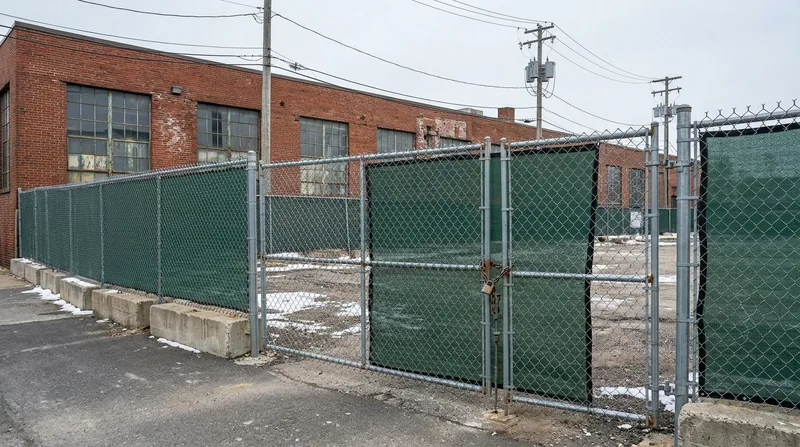




Commercial fence installation in Boston demands speed, code compliance, and materials that stand up to nor'easters, freeze-thaw cycles, and salt air. Whether you're securing a construction site in Dorchester, containing a demolition zone in Brookline, or protecting landscaping on a Newton jobsite, temporary and permanent commercial fencing must go up fast and hold hard through New England weather. We install commercial chain link, security fencing, temporary construction fence, and silt fence for general contractors, builders, property managers, and municipal crews across Boston and Eastern Massachusetts. Post holes driven into glacial till and ledge, chain link tensioned tight against wind load, and gate hardware rated for daily cycle, this is jobsite fencing that earns its cost.
Why Commercial and Temporary Fencing Matters on Boston Jobsites
Construction sites in Boston operate on tight schedules and tighter budgets. A fence that sags, rusts, or fails inspection halts work, triggers fines, and damages your reputation with the city. Temporary fencing must meet Boston building code sight-line and fall-protection standards, contain dust and debris on dense urban lots, and survive the weather that hammers exposed sites. Permanent security fencing around commercial properties, parking areas, and equipment yards needs to resist cutting, climbing, and the corrosive salt spray that reaches inland from the harbor and drifts from winter road salt.
- Temporary fencing on active construction sites must comply with fall-protection and perimeter-containment codes set by the Boston Building Department.
- Silt fence prevents sediment and storm runoff from leaving the jobsite and entering storm drains, a requirement for stormwater permits across Greater Boston.
- Chain link tensioned correctly and braced against wind resists the gale-force gusts that accompany nor'easters and coastal storms.
- Gate hardware and fasteners must be galvanized or powder-coated to survive salt air and freeze-thaw corrosion that degrades unprotected steel in months.
- Fast installation minimizes jobsite downtime and keeps your crew on schedule in a market where weather windows are narrow.
Meeting these standards the first time avoids re-work, fines, and schedule slips that cascade through a project timeline.
Key info: Boston and surrounding municipalities require permits for temporary construction fencing and silt fence installation. Contact your local building department or the Boston Building Department to confirm setback, height, and perimeter-containment rules for your specific site and neighborhood.
How We Install Commercial and Temporary Fencing Across Boston
Every jobsite is different. A demolition site in South Boston faces different constraints than a new-construction zone in Needham or a utility work area in Quincy. We start with an on-site survey, confirm utility locations using Massachusetts 811 locates, and lay out the fence line to meet code setbacks, sight-line requirements, and your project boundaries. Posts are set in concrete or tamped depending on soil and frost depth, chain link is tensioned to resist wind load, and gates are hung plumb and square with hardware rated for the duty cycle your site demands.
- We call 811 for utility locates before any post hole is dug, a legal requirement in Massachusetts.
- Posts are set in concrete at depths below the frost line, typically 3 to 4 feet in the Boston area, to resist heave from freeze-thaw cycles.
- Chain link is pulled tight using stretcher bars and tension bands, then braced with anti-sag cable or diagonal bracing where wind load or long spans demand it.
- Gates are hung with self-closing and self-latching hardware on cantilever or V-track systems, depending on grade and gate width.
- Silt fence is installed on contour with geotextile stapled to wooden stakes, designed to shed runoff and trap sediment before it leaves the site.
This process keeps your site secure, compliant, and ready to move to the next phase without delay.
Real example: A foundation excavation in Milton required temporary perimeter fencing around an active site with utilities running through the lot. We located all underground lines with 811, set posts in concrete below frost depth to prevent heave, installed 6-foot chain link with anti-sag bracing on the windward side, and hung a cantilever gate wide enough for equipment access. The fence held through two nor'easters and stayed plumb through the winter frost cycle.
Commercial Fencing Methods and Materials for Boston Jobsites
| Approach | Description | Best for |
|---|---|---|
| Commercial Chain Link | Galvanized or vinyl-coated 11-gauge mesh in 1.25 or 1.5 inch diamond, set in concrete posts with stretcher-bar tension and anti-sag cable or diagonal bracing. | Active construction sites, equipment yards, parking perimeters, and temporary containment where visibility and durability are priorities. |
| Temporary Construction Fence | 6 or 8 foot portable or fixed chain link panels, often with privacy slats, installed on temporary posts or weighted bases for quick setup and removal. | Short-term jobsites, utility work, and demolition zones where the fence is removed after project completion. |
| Silt Fence and Sediment Control | Geotextile fabric stapled to wooden stakes, installed on contour to intercept stormwater runoff and trap sediment before it leaves the site. | Stormwater permit compliance on grading, foundation, and demolition work in areas with storm-drain connections or wetlands. |
| Ornamental or Security Fencing | Powder-coated aluminum or steel with welded posts and frames, installed for permanent commercial properties, parking areas, and utility enclosures. | Long-term security, visual appeal, and corrosion resistance in high-salt or high-traffic environments. |
Each method is chosen based on site duration, weather exposure, code requirements, and your budget. We can advise on the best fit during a free site visit.
Commercial and Temporary Fencing Cost in Boston: What to Expect
Commercial fencing costs depend on material, height, post spacing, site access, and whether utilities or ledge complicate installation. Chain link runs lower per linear foot than ornamental steel or security fencing, but a large perimeter or difficult terrain can shift the total quickly. Temporary fencing often costs less than permanent work because posts are not set as deep and the fence is removed after the project ends. Silt fence is priced by linear foot and by the number of stakes and geotextile material needed.
A free site quote is the only way to get an accurate number. We visit your jobsite, measure the perimeter, identify obstacles, confirm utility locations, and review code requirements with you. From there, we provide a fixed price for the work and a realistic timeline. Most jobsites in the Boston area see installation within 3 to 5 business days of the estimate, depending on weather and material availability.
For detailed pricing guidance and examples, visit our pricing page. If you're comparing quotes, ask each contractor about galvanizing or coating specs, gate hardware quality, post depth, and warranty on materials and labor. The cheapest bid often reflects corners cut on durability, and corners cut on a jobsite fence show up fast.
What to Look for When Hiring a Fence Contractor Near Boston
Commercial fencing requires a contractor who understands code, knows the local soil and climate challenges, and can move fast without cutting quality. When you're evaluating contractors near Boston or in surrounding towns, ask the right questions and verify the basics before signing a contract.
- Confirm that the contractor carries general liability and workers compensation insurance and can provide a certificate of insurance on request.
- Ask whether a permit is required for your specific site and neighborhood; the rules vary across Boston, Quincy, Newton, Brookline, and other communities, so verify with your local building department.
- Request references from recent jobsites in your area and call them to ask whether the fence was installed on time, whether it held up through weather, and whether the crew cleaned up after themselves.
- Get at least two or three written estimates so you can compare materials, methods, timeline, and price without pressure.
- Confirm that the contractor will call 811 for utility locates before digging any post holes, a legal requirement in Massachusetts.
Take your time with the selection. A fence that fails mid-project or doesn't hold through winter costs more to fix than it would have cost to install right the first time. Call us at (857) 767-9232 for a free estimate and honest guidance on your project, or visit our contact page to request a site visit.
Commercial & Temporary Fencing in Boston: Pricing Guide
| Service | Price | Details |
|---|---|---|
| Commercial chain link fence | Free site quote | Measurement, utility locate, code review, and material estimate. No obligation to book. |
| Temporary construction fence | Starting at $8-$15 per linear foot | Installed height, mesh gauge, post depth, bracing, and site access determine the final price per foot. |
| Silt fence and sediment control | Starting at $3-$6 per linear foot | Geotextile material, stake spacing, and ground contour affect cost. Permits and stormwater compliance included. |
| Security or ornamental fencing | On estimate | Material, height, welding, powder coating, and gate hardware drive cost. Site survey required for accuracy. |
| Travel and site visit | Included | No mileage fee or call-out charge for Boston and surrounding communities in Eastern Massachusetts. |
| Estimate | Free | Response within 24 hours at (857) 767-9232. No charge, no obligation to proceed. |
Indicative pricing, the exact cost depends on square footage, finish, and site access. Free personalized estimate within 24h at (857) 767-9232.


