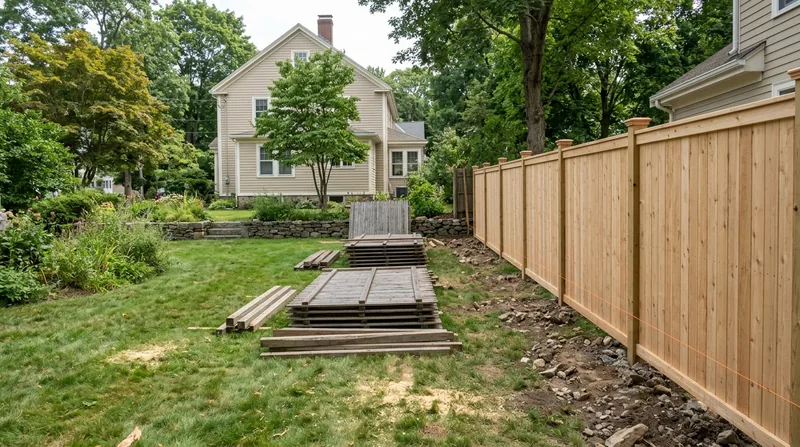




Boston's oldest neighborhoods pack tight wood-frame triple-deckers and rowhouses with narrow backyards bounded by six-foot white-cedar and pressure-treated pine privacy fences, while the suburbs are lined with white vinyl and classic picket. Those fences are taking a beating. Nor'easters with gale winds and heavy wet snow heave posts out of the ground, freeze-thaw cycles crack rails and stringers, salt air near the harbor corrodes fasteners and metal, and the rocky glacial till that sits under most yards makes post replacement a chore when ledge blocks the hole. When repair no longer holds the line, fence replacement and removal in Boston means a complete tear-out, haul-away, and rebuild, or a straight removal if that is all you need. We reuse what is sound, replace what is not, and quote repair versus full replacement side by side so you decide with real numbers. Call (857) 767-9232 for a free estimate, or read on to understand what goes into the job and why timing matters in New England.
Why Fence Replacement and Removal Matter in Boston's Changing Yards
A fence in Boston does not last forever. The combination of deep winter frost, salt spray from the harbor and winter road treatment, and the sheer weight of nor'easter snow creates the perfect storm for post heave, rail rot, and fastener corrosion. Many fences built in the 1980s and 1990s are now at the end of their useful life, especially the first generation of pressure-treated pine that relied on older preservatives. When posts shift, rails sag, or pickets split and warp, the question is not always whether to fix it, but whether to fix it or replace it. Removing an old fence and starting fresh also opens the door to upgrading material, height, or style to match your property better or to comply with updated zoning setbacks and HOA architectural standards.
- Frost heave and freeze-thaw cycles push posts out of plumb, especially in yards with clay-rich or poorly drained soil common across inner Boston.
- Salt air and road salt corrode galvanized fasteners and cause rust staining on vinyl and metal components.
- Nor'easter snow and wind loads bend or snap rails and stress posts set too shallow or in shallow soil over ledge.
- Rot at the ground line is the most common failure point for wood fences, because moisture wicks up from wet soil into untreated or poorly sealed wood.
- A full removal and rebuild lets you relocate the fence line, upgrade to a material that suits your climate better, or comply with a change in local zoning or HOA rules.
Knowing when to repair and when to replace is the difference between a smart spend and money down the drain.
Key info: Boston's building inspector and zoning board set fence height, setback, and material rules, and they vary across the city and inner suburbs. Before you plan a replacement, check your local building department and review any HOA architectural standards. See the City of Boston's zoning code at boston.gov/inspectional-services or contact your town hall for setback and height limits in your neighborhood.
How We Remove and Replace Fences in Boston: Step by Step
Fence removal and replacement is straightforward in concept but demands attention to detail on site. We start by calling 811 to locate underground utilities, because hitting a cable or gas line turns a routine job into a catastrophe. Once the site is clear, we tear out the old fence, cut posts at or below grade, haul debris, and prep the ground. If you are rebuilding, we then set new posts in concrete or tamped soil depending on your preference and soil conditions, install rails and stringers, attach pickets or panels, and finish with cap and trim. If you are removing only, we clear the line completely and leave the ground ready for landscaping or a new fence down the road.
- Call 811 at least 48 hours before we dig to request a utility locate and mark underground lines.
- We tear out the old fence, including posts, rails, and pickets, and cut posts below grade to prevent tripping hazards.
- Debris is hauled away or recycled; we can salvage sound wood or metal if you want to reuse it elsewhere on the property.
- We measure and lay out the new fence line, checking setbacks against your property survey and local zoning rules.
- Posts are set in concrete or tamped soil at 4 to 6-foot spacing, depending on terrain and fence height; rocky soil or ledge may require drilling or adjusting post location.
- Rails and stringers are installed level and plumb, with anti-sag bracing on taller fences or those exposed to wind.
- Pickets, boards, or panels are attached, spaced, and trimmed; cap and trim finish the top and edges.
- Final cleanup removes dust and sawdust, leaving the yard ready to use.
The timeline depends on fence length, soil conditions, and whether you are removing only or removing and rebuilding. A typical 100-linear-foot privacy fence removal and replacement takes 2 to 4 days.
Example: A South Boston triple-decker with a rotted cedar privacy fence along a 60-foot backyard line needed full replacement. The old posts were set in tamped soil over clay, and frost heave had shifted the line 2 inches over 25 years. We removed the old fence, set new pressure-treated posts in concrete footings 3 feet deep to clear the frost line, installed new cedar rails and pickets, and finished with a cap rail and trim. The job took 3 days and cost $3,800. The homeowner chose cedar over vinyl because it matched the historic character of the neighborhood and cost less upfront, though it will need staining every 5 to 7 years to hold up to salt air.
For more detail on repair versus replacement decisions, see our fence repair page.
Removal and Replacement Methods for Different Fence Types
| Fence Type | Removal Process | Replacement Notes |
|---|---|---|
| Wood Privacy Fence | Cut posts below grade with a reciprocating saw, pull rails and boards, extract posts by hand or with a power auger if frozen or deep-set in concrete. | Pressure-treated pine or cedar, posts set 3 feet deep in concrete, 4-foot post spacing for 6-foot height, board-on-board or side-by-side style, cap rail and trim included. |
| Vinyl Privacy Fence | Unscrew or unbolt vinyl panels from posts, remove posts by extraction or drilling out concrete footings if deep-set. | New vinyl panels snap onto aluminum or vinyl posts, no painting or staining, durable in salt air and freeze-thaw, higher upfront cost but lower maintenance. |
| Chain Link Fence | Remove tension bands and stretcher bar holding the mesh, unroll and roll up mesh, cut and remove posts from concrete footings or by extraction. | New mesh is stretched and tensioned on new posts, galvanized or vinyl-coated steel, 11 or 9-gauge depending on height and exposure, posts set 6 feet apart for 4-foot height. |
| Ornamental Metal or Cast Iron | Unbolt pickets and rails from posts, remove posts by extraction or concrete removal, salvage metal for reuse or recycling if in good condition. | Powder-coated aluminum or new wrought iron, smaller post spacing (2 to 3 feet), traditional or contemporary profile, common in front yards and historic neighborhoods like Beacon Hill and Back Bay. |
Fence Replacement and Removal Cost in Boston: What to Expect
Cost for fence removal and replacement in Boston starts at around $2,400 for a basic 100-linear-foot privacy fence removal and rebuild with pressure-treated pine and standard post spacing. That figure assumes level ground, no buried ledge, accessible site, and no special finishes. The real cost depends on several concrete factors: fence length in linear feet, material choice (wood versus vinyl versus metal), height and post spacing, soil conditions and whether ledge sits where posts need to go, site access for equipment and debris haul, and whether you are removing only or removing and rebuilding. A 150-foot vinyl privacy fence replacement on a sloped lot with ledge and tight site access can easily run $5,500 to $7,000. Ornamental metal or cast iron runs higher because of material cost and installation precision. Chain link is the least expensive option, typically $1,200 to $2,500 for 100 linear feet of 4-foot height.
The best way to understand your cost is to get 2 or 3 estimates on site. We provide a free estimate within 24 hours at (857) 767-9232 with no obligation to book. See our pricing page for more detail on how material, height, and site conditions move the needle.
What to Look for When Hiring a Fence Contractor Near Me in Boston
Hiring the right contractor for fence removal and replacement near you in Boston means checking a few key boxes. First, confirm that the contractor carries full insurance, including general liability and workers' compensation coverage; ask for a certificate of insurance and verify it is current. Check with your local building department to see if a permit is required and what rules apply in your neighborhood. Third, get at least 2 or 3 estimates in writing, and do not pick based on price alone; the lowest bid often means corners cut on post depth, concrete, or labor. Fourth, ask for references from recent jobs in your neighborhood or with a similar fence type, and call them. Fifth, confirm that the contractor will call 811 before digging and will respect any HOA architectural standards or deed restrictions on your property. Finally, discuss whether repair or replacement makes sense for your fence; a good contractor will propose repair first if it is the smarter spend.
Ready to move forward? Contact us for a free estimate or call (857) 767-9232.
Fence Replacement & Removal in Boston: Pricing Guide
| Service | Price | Details |
|---|---|---|
| Wood Privacy Fence Removal & Replacement | Starting at $2,400 | 100 linear feet, pressure-treated pine, 6-foot height, level ground, posts set in concrete, standard spacing and cap rail included |
| Vinyl Privacy Fence Removal & Replacement | Starting at $3,600 | 100 linear feet, vinyl panels on aluminum posts, 6-foot height, no maintenance, durable in salt air and freeze-thaw, higher upfront cost but lasts 20+ years |
| Chain Link Fence Removal & Replacement | Starting at $1,200 | 100 linear feet, 4-foot height, galvanized or vinyl-coated steel, 11-gauge mesh, most affordable option for large yards and boundary lines |
| Ornamental Metal or Cast Iron Fence Removal & Replacement | Starting at $4,200 | 100 linear feet, powder-coated aluminum or wrought iron, 3 to 4-foot height, closer post spacing, traditional or contemporary profile, common in historic neighborhoods |
| Fence Removal Only (No Rebuild) | Starting at $800 | 100 linear feet, posts cut below grade, debris hauled away, ground prepped for landscaping or future fence installation, haul-away and site cleanup included |
| Complex or Large-Scale Job | On estimate | Ledge removal, sloped or rocky terrain, site access constraints, specialty materials, or jobs over 200 linear feet require on-site assessment and custom pricing |
Indicative pricing, the exact cost depends on square footage, finish, and site access. Free personalized estimate within 24h at (857) 767-9232.


